


How Flame Sensors Work
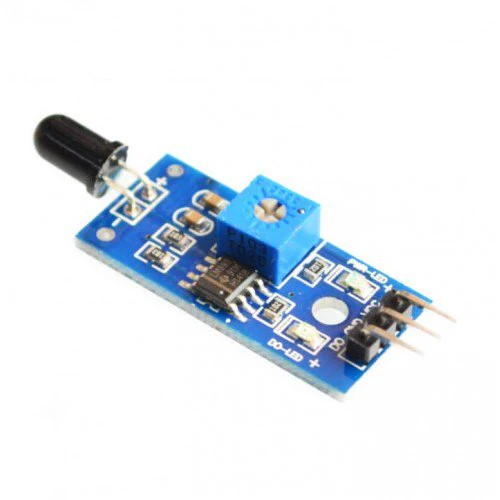
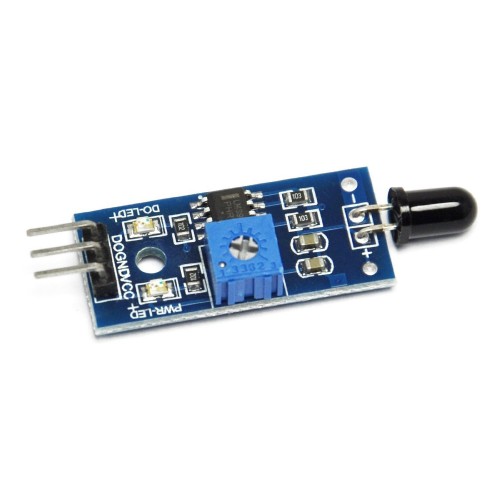
Most low-cost, hobbyist flame sensors, such as the widely available KY-026 module, utilize an infrared-sensitive photodiode or phototransistor. More advanced industrial sensors use specialized UV or dual-spectrum detectors for greater accuracy and immunity to false alarms.
1. Infrared (IR) Flame Sensor
The most common type relies on the characteristic flicker frequency of a flame in the infrared spectrum.
- Detection Principle: Flames emit significant energy across the electromagnetic spectrum. A key characteristic is the flickering produced by the combustion process. This flickering occurs at specific low frequencies, typically between $3\text{ Hz}$ and $30\text{ Hz}$.
- Sensor Component: The sensor uses an IR Photodiode or a Phototransistor which is highly sensitive to IR radiation, particularly at the $\sim 760\text{ nm}$ to $1100\text{ nm}$ range.
- Filtering: The sensor module often includes circuitry to filter out the steady background IR radiation (like from sunlight or incandescent lights) and specifically look for the unique flicker signature of a flame, minimizing false positives.
2. Ultraviolet (UV) Flame Sensor
Advanced, high-reliability sensors often use UV detectors.
- Detection Principle: A flame produces high-energy UV radiation, primarily in the $185\text{ nm}$ to $260\text{ nm}$ range.
- Sensor Component: These sensors use a UV-sensitive component (e.g., a UV tube or a special silicon carbide photodiode) that only responds to the high-energy UV photons.
- Benefit: Since most artificial light sources and sunlight on Earth’s surface do not emit UV in this specific band (the ozone layer blocks it), UV sensors are excellent for preventing false alarms.
Module Specifications (Hobbyist Type)
The common flame sensor module (like the KY-026) is easy to interface with microcontrollers such as the Arduino.
| Feature | Specification |
| Detection Method | Infrared (IR) Photodiode |
| Operating Voltage | $3.3\text{V}$ to $5\text{V}$ DC |
| Detection Angle | Varies, typically around $60^\circ$ |
| Detection Distance | Up to $1 \text{m}$ (for a standard flame) |
| Output Type | Analog (AO) and Digital (DO) |
Pinout
The module typically has four pins:
| Pin | Function | Description |
| $\text{V}_{\text{CC}}$ | Power Supply | Connects to $+5\text{V}$. |
| GND | Ground | Connects to Ground (0V). |
| AO (Analog Output) | Signal Strength | Provides a variable voltage (proportional to IR intensity) for distance or strength monitoring. |
| DO (Digital Output) | Alert Trigger | Outputs a HIGH or LOW signal when the detected IR intensity crosses a pre-set threshold. |
The potentiometer on the module board is used to adjust the sensitivity of the sensor, which controls the switching point for the Digital Output (DO).
Applications
Flame sensors are crucial components in various safety and detection systems:
- Fire Alarm Systems: Activating alarms or automatic suppression systems.
- Robotics: Used in fire-fighting robots to locate the source of a flame.
- Industrial Safety: Monitoring combustion chambers, burners, and high-temperature processes.
- Home Safety: Simple home fire detection prototypes when coupled with microcontrollers.
Be the first to review “Flame Sensor”
Related products
Reviews
There are no reviews yet.