
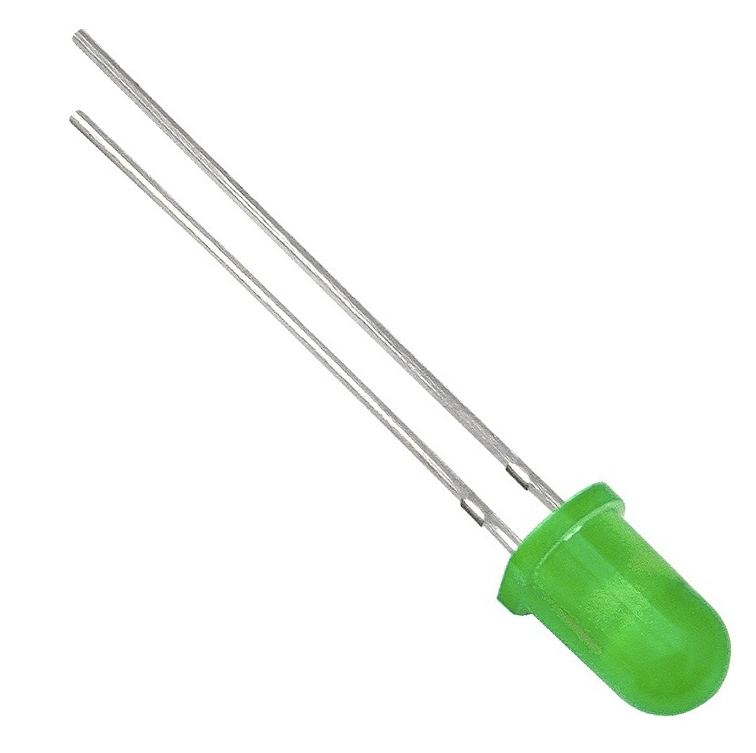
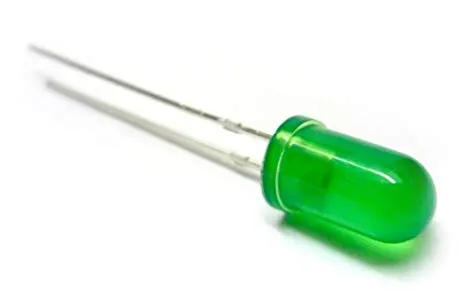
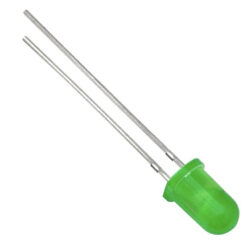

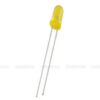
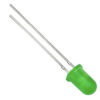
Green LED
₵0.50
A Green LED (Light Emitting Diode) is a semiconductor light source commonly used as a status indicator, for signaling, and in full-color display systems. Its color is determined by the specific materials used in the diode’s construction, which govern the energy of the emitted photons.
945 in stock
🚚 Same-day delivery in Kumasi · Next-day nationwide
💳 Pay with MoMo, VISA or bank transfer
Composition and Wavelength
The color of the emitted light depends on the band gap energy of the semiconductor material. Green LEDs can be manufactured from a few different material systems, resulting in slight variations in color, brightness, and voltage:
- Standard Green (Yellowish-Green): Often uses Gallium Phosphide ($\text{GaP}$) or Aluminum Gallium Phosphide ($\text{AlGaP}$).
- Wavelength ($\lambda_D$): Typically around $560\text{ nm}$ to $570\text{ nm}$ (nanometers), which is closer to the yellow-green portion of the spectrum.
- Forward Voltage ($\text{V}_f$): Usually around $2.0\text{V}$ to $2.2\text{V}$.
- High-Brightness/True Green: Modern, highly efficient green LEDs typically use Indium Gallium Nitride ($\text{InGaN}$).
- Wavelength ($\lambda_D$): Closer to $520\text{ nm}$ to $530\text{ nm}$ (a “truer” green).
- Forward Voltage ($\text{V}_f$): Can be significantly higher, often ranging from $3.0\text{V}$ to $3.5\text{V}$ (similar to Blue and White LEDs).
Electrical Requirements
Like all LEDs, a Green LED is a polarized component and must be connected with the correct polarity (forward-biased) and a current-limiting resistor to prevent burnout.
- Forward Current ($\text{I}_f$): Standard LEDs are rated for about $10\text{ mA}$ to $20\text{ mA}$.
- Polarity: The Anode (longer lead) connects to the positive voltage, and the Cathode (shorter lead/flat edge on the casing) connects to the negative (Ground).
Resistor Calculation
The value of the series current-limiting resistor ($R$) is found using Ohm’s Law:
Using an average $\text{V}_f$ of $2.2\text{V}$ for a standard green LED and a $5\text{V}$ supply, targeting $20\text{mA}$ ($0.020\text{A}$):
You would typically choose the nearest standard resistor value, such as $150\ \Omega$.
Common Applications
Green LEDs are used in a variety of status and signaling roles:
- Status Indicators: Commonly signify “Power On,” “Active,” “Safe,” or “Ready” status on electronic equipment, control panels, and appliances.
- Traffic Signals: The primary color for “Go” in traffic lights, requiring highly efficient and durable true-green LEDs.
- RGB Displays: The green sub-pixel is often the most critical for overall display brightness, as the human eye is most sensitive to green light. They are a core component in full-color LED screens, video walls, and display backlighting.
- Horticultural Lighting: While red and blue light are primary for photosynthesis, green light is important for canopy penetration and regulating plant growth deep within foliage.
Be the first to review “Green LED”
Related products




Reviews
There are no reviews yet.