



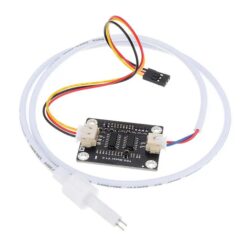
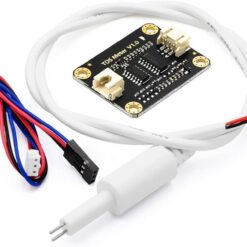
TDS/EC Sensors — Pack of 5 Analog TDS Meter Sensors
₵110.00
This set of 5 Analog TDS/EC Sensors is designed for accurate measurement of Total Dissolved Solids (TDS) and Electrical Conductivity (EC) in water. These sensors are ideal for water-quality monitoring projects, hydroponics, aquariums, environmental testing, filtration systems, and microcontroller-based experiments using Arduino, ESP32, or other analog-input platforms.
9 in stock
Key Features
-
High-Precision Measurement: Provides stable and accurate readings of water TDS/EC levels.
-
Analog Output: Easy interface with Arduino, ESP32, STM32, and other microcontrollers.
-
Corrosion-Resistant Probe: Long-life stainless steel probe ensures durability in wet environments.
-
Temperature Compensation: Built-in circuitry helps reduce reading errors caused by temperature changes.
-
5-Piece Pack: Ideal for multi-sensor setups, classroom labs, IoT systems, or bulk purchases.
-
Plug-and-Play: Includes signal board + detachable probe for easy installation.
Typical Technical Specifications
(Values may vary slightly by model)
-
Supply Voltage: 3.3V – 5V
-
Output Type: Analog voltage (0–2.3V typical)
-
TDS Measurement Range: 0 – 1000 ppm (some models support up to 3000 ppm)
-
EC Measurement Range: 0 – 20 mS/cm (approx.)
-
Temperature Compensation: ~25°C reference
-
Probe Type: Stainless steel immersion probe
-
Cable Length: 60–100 cm (depending on version)
-
Signal Board: Built-in op-amp & filtering circuit
Applications
-
Hydroponics nutrient monitoring
-
Drinking-water quality testing
-
Aquaculture and aquarium ecosystems
-
Laboratory experiments & school science kits
-
Water purification and filter performance testing
-
IoT water-monitoring systems
-
Smart agriculture
How It Works
The TDS/EC sensor measures the electrical conductivity of water, which correlates with the concentration of dissolved ions. The onboard signal-conditioning board converts this into a clean analog voltage that a microcontroller can read and convert into EC (mS/cm) or TDS (ppm) using simple formulas.
Be the first to review “TDS/EC Sensors — Pack of 5 Analog TDS Meter Sensors”
Related products
Reviews
There are no reviews yet.