



How the DHT11 Works
The DHT11 utilizes two primary sensing components and an internal 8-bit microcontroller to process the data:
- Capacitive Humidity Sensor: This component measures relative humidity (RH). It consists of two electrodes with a moisture-holding substrate (like a conductive plastic polymer) between them. As the humidity changes, the substrate absorbs or loses water vapor, which changes the capacitance between the electrodes.
- NTC Thermistor: This component measures temperature. NTC stands for Negative Temperature Coefficient, meaning its electrical resistance decreases as the ambient temperature increases.
The internal microcontroller converts the analog signals from the capacitive sensor and the thermistor into a single, calibrated digital signal for output. This digital signal, a 40-bit data packet, is sent over a single-wire interface to a microcontroller (like an Arduino or Raspberry Pi).
Key Specifications
| Feature | Specification |
| Operating Voltage | 3.5V to 5.5V DC |
| Humidity Range | 20% to 90% RH |
| Humidity Accuracy | $\pm 5\%$ RH |
| Temperature Range | $0^\circ\text{C}$ to $50^\circ\text{C}$ |
| Temperature Accuracy | $\pm 2^\circ\text{C}$ |
| Output | Single-wire digital signal |
| Sampling Rate | Max 1 Hz (one reading per second) |
Note: The DHT11 is often compared to the DHT22 (AM2302), which is more expensive but offers a wider range and better accuracy (e.g., $\pm 0.5^\circ\text{C}$ accuracy).
Pinout and Connection
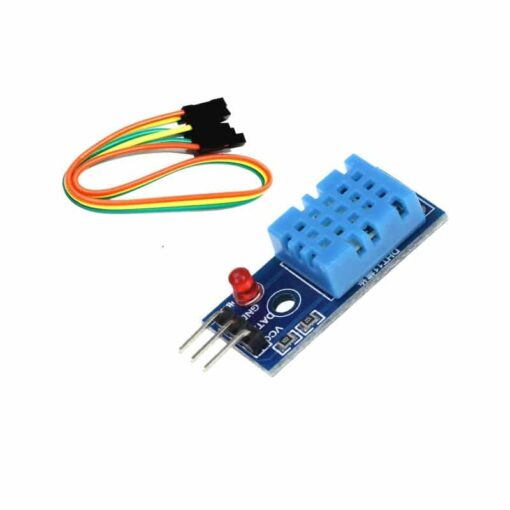
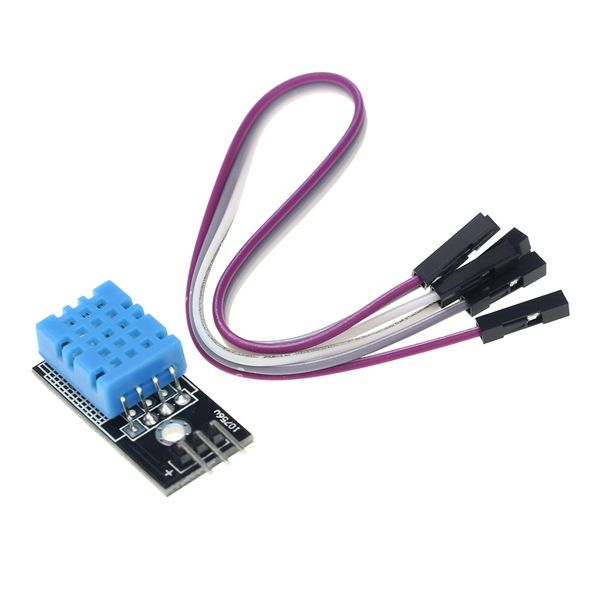
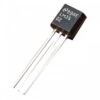
The DHT11 sensor is available in two main formats: a 4-pin package and a 3-pin module (the module is generally easier to use as it often includes the necessary pull-up resistor and filtering capacitor).
| Pin (4-Pin Sensor) | Pin (3-Pin Module) | Function | Connection |
| VCC (Pin 1) | VCC / + | Power Supply | 3.3V or 5V |
| Data (Pin 2) | Data / Out | Serial Data Output | To a digital I/O pin on MCU |
| NC (Pin 3) | GND / – | Not Connected | N/A |
| GND (Pin 4) | GND / – | Ground | Ground (GND) |
A pull-up resistor (typically $4.7\text{k}\Omega$ to $10\text{k}\Omega$) is usually required between the VCC and Data pins to ensure the data line remains high when the sensor is idle. This resistor is often built into the 3-pin module version.
Common Applications
- Home Automation: Basic climate control and monitoring.
- Weather Stations: Low-cost environmental data logging.
- Terrarium/Greenhouse Monitoring: Ensuring optimal temperature and humidity for plants or animals.
- DIY Projects: Used in countless hobbyist projects requiring ambient condition data.
Be the first to review “DHT11 Temperature and Humidity Sensor”
Related products
Reviews
There are no reviews yet.